Atomic Structure and Periodic Table
1) What is Matter ?
Anything that has mass and takes up space is recognised as matter. All stuff/materials are matter.
2) What is Mass and how can it be measured ?
Mass is a measure of the amount of matter in an object. Mass is usually measured in grams (g) or kilograms (kg).
It can be measured using a "top pan balance".
3) What is a Particle ?
Matter is made up of particles.
A particle can be an atom, a molecule or an ion.
Particles are very small and can only be seen with a microscope.
4) What is an Atom ?
This is the smallest unit of matter.
An atom can contain positive and negative charge
It is composed of three sub-atomic particles:
Electron - (found outside the nucleus) This has the negative charge (these can move)
Neutron - (found inside the nucleus) This has a neutral charge (these can move but require a strong nuclear force)
Proton - (found inside the nucleus) This is the positive charge (these cannot move)
5) What is an Electron ?
An electron is a tiny, sub-atomic particle that has a negative electric charge.
6) What is a Nucleus ?
This is the central part of an atom containing just protons and neutrons.
The protons have a +1 charge
The outside part of an atom contains electrons that have a -1 charge.
7) What is the Electronic Structure ?
This is a diagram or notation used for indicating how many electrons are arranged across the different energy levels.
1st subshell - max 2
2nd subshell - max 8
3rd subshell - max 8
4th subshell - max 2
The periodic group number tells you how many electrons there are in the 3rd subshell.
This rule does not apply to group 0.
8) What is the Periodic Table ?
Every element has a name and a symbol (one or two letters).
Depending on the temperature every element can be changed into solid, liquid or gas.
The periodic table provides a list of all the different elements.
The elements are arranged based on the atomic number (number of protons in the nucleus of each atom) and the physical and chemical properties of each element.
Each column is called a group and has similar physical and chemical properties.
The table is divided into groups (which go down) and periods (which go across).
For example the first group are all soft, shiny metals.
9) Can you describe the earlier versions of the Periodic Table ?
1864 - John Newlands - arranged in order of atomic weight. He noticed that every eighth element had similar chemical and physical properties.
1869 - Dmitri Mendeleev - 50 known elements arranged in order of atomic weight but exceptions were made when the properties were similar.
Modern tables - Arranged by atomic number (the number of protons).
10) What is an Element ?
An element is made of only one type of atom. Everything in the periodic table is an element.
O - one Oxygen atom
H2O - two Hydrogen atoms
11) In some elements, are the atoms chemically bonded ?
Yes some elements have chemically bonded atoms.
Hydrogen contains hygrogen atoms that have created a single covalent bond
Oxygen contains oxygen atoms that have created a double covalent bond
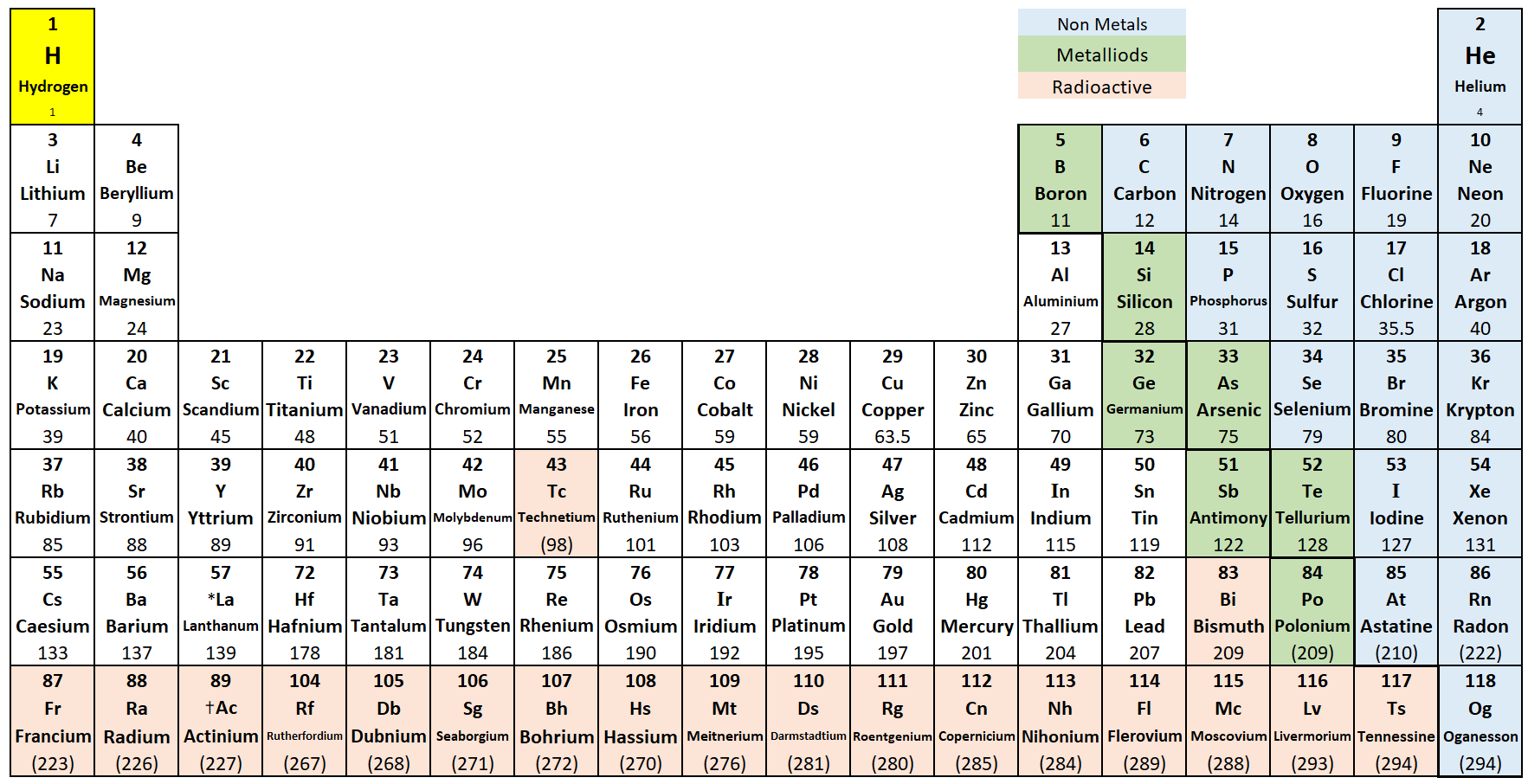
12) How many elements are there in the periodic table ?
118 in total. 95 metals (including 7 metalloids), 22 non-metals
 |
13) Can you describe some physical properties of Metals ?
Reactivity Increases as you go DOWN.
Metals conduct electricity
Metals conduct energy
Metals are strong and tough
Metals are shiny when polished
Metals are sonorous
Metals are ductile
Metals have high densities
Metals have high melting and boiling points
14) Can you describe some physical properties of Non-Metals ?
Reactivity Increases as you go UP.
Non-metals don't conduct electricity
Non-metals don't conduct energy (by heating well)
Non-metals are not strong or hard wearing
Non-metals are dull
Non-metals are brittle
Non-metals have low densities
Non-metals have low melting and boiling points
15) What are the Transition Metals ?
They are found in the central block between column 3 and column 12.
They include: Iron (Fe), Copper (Cu), Gold (Au), and Silver (Ag). They are hard, shiny, strong, high melting point, high density.
16) What are the Metalloids ?
These are the elements that sit between the typical metals and non-metals.
There are 7 metalliods: Boron (B), Silicon (Si), Germanium (Ge), Arsenic (As), Antimony (Sb), Tellurium (Te) and Polonium (Po)
17) How many elements are in Group 3 ?
There are 4 elements: Scandium (Sc), Yttrium (Y), Lutetium (Lu), Lawrencium (Lr)
18) How many outer electrons do the elements in Group 3 have ?
Most of the Group 3 elements have 2 outer electrons because they start filling an inner electron shell rather than their outermost shell.
19) How many elements are in Group 7 ?
There are 6 elements: Fluorine (F), Chlorine (Cl), Bromine (Br), Iodine (I), Astatine (At), Tennessine (Ts)
They are called the Halogens
These are non-metals with coloured vapours.
20) What groups are these elements in:
Sodium - Group 1
Magnesium - Group 2
Aluminium - Group 3
Carbon - Group 4
Nitrogen - Group 5
Oxygen - Group 6
Chlorine - Group 7
Helium - Group 0
Hydrogen - no group, at the top on its own
21) What is the difference between Reactivity and Radioactivity ?
Chemical reactivity and radioactivity happen in different parts of the atom.
Reactivity - involves an atom's outer electrons changing how they bond with other atoms.
Radioactivity - involves an unstable nucleus breaking down at the core of the atom.
22) What does the word Unstable mean ?
The word "unstable" can mean two completely different things depending on whether you are talking about chemical reactivity or radioactivity.
When an atom is "chemically unstable," it refers strictly to the outer electron shell.
When an atom is "nuclear unstable," it refers strictly to the nucleus (the core).
23) What is the Reactivity Series ?
This is a list that ranks all the metals in order of their chemical reactivity from most reactive to least reactive.
Metals all react by losing electrons to form positive ions.
Non-metals react by gaining (or sharing electrons) to form negative ions.
Atoms crave stability. If an atom does not have a full outer shell, it is chemically unstable and will react to get one.
24) How many of the elements in the periodic table are Chemically Unstable ?
111 are chemically unstable and will always try to reactive.
The only elements that do not crave chemical stability are the Noble Gases.
They already have perfectly full outer electron shells, so they have no reason to react.
25) What is a Chemical Reaction ?
This is a process in which one or more substances are converted into one or more different substances.
26) Can you describe what happens in a chemical reaction ?
Atoms are not changed or destroyed.
Atoms move around.
The mass does not change (the products weigh the same as the reactants).
There is always a transfer of energy to or from the surroundings.
27) What is a Chemical Formula ?
Shows one specific pure substance or molecule.
Uses element letters and small bottom numbers (subscripts).
Tells you the type and count of atoms inside that substance.
28) What is a Chemical Equation ?
This is a way to show a chemical reaction using letters and numbers.
Shows a complete chemical change or reaction. Use an arrow to indicate the reactants and products.
Uses big numbers in front (coefficients) to balance the total amounts.
29) How many of periodic table elements are Nuclear Stable ?
80 are nuclear stable.
Nuclear stable means they have at least one version that is not radioactive.
The first 82 elements are all nuclear stable, with just 2 exceptions.
All of these nuclear stable elements can be made radioactive.
30) Do some of the elements in the periodic table only exist in a radioactive, unstable state ?
Yes, 38 elements on the periodic table exist exclusively in a radioactive, unstable state.
These elements have absolutely no stable isotopes.
31) What is the Atomic Number ?
The atomic number is the number of protons in the nucleus.
This is always the smallest number.
32) What is the Relative Mass Number ?
This number is based entirely on their naturally occurring stable versions.
The mass number is the total number of protons and neutrons in the nucleas.
This is always the largest number.
33) Why is the relative atomic mass of Chlorine 35.5 ?
Chlorine actually has 24 isotypes and 2 of these are stable.
Chlorine elements on Earth are always a combination of roughly 75% stable Chlorine-35 and 25% stable Chlorine-37.
34) Why do all the elements that only exist in a radioactive, unstable state have a negative relative atomic mass number ?
There are no stable versions to average out.
Because these elements are actively decaying, scientists cannot give a permanent average
This number is based on the most stable isotype.
35) What is an Isotope ?
Isotypes are different forms of the same element.
All Isotypes have the same atomic number = the same number of protons.
Isotypes of the same element all have different atomic mass numbers becuase they all have a different number of neutrons.
Over 90% of all Isotypes are unstable / radioactive.
36) What is a Molecule ?
Made of two or more atoms chemically bonded, due to a chemical reaction. They may or may not be the same type of atom.
H2 - two Hydrogen atoms
O2 - two Oxygen atoms
CO2 - different atoms
37) What is a Compound ?
Compounds are molecules that have different types of atoms
Two or more different substances that have been chemically bonded.
All compounds are molecules.
CO2
38) How are Compounds formed ?
Compounds can be formed in two ways:
All compounds are chemically unreactive because they have a full shell of electrons.
Covalent Bonding (sharing electrons)
Ionic Bonding (transferring electrons)
39) What is the difference between Molecules and Compounds ?
Molecules can be elements or compounds.
40) What is the difference between Molecules and Elements ?
Elements are made up of only one type of atom.
Molecules can be made up of different types of atoms.
41) What is the difference between Molecules and Particles ?
Particles is a broad umbrella term for any tiny unit of matter.
Molecules are a specific type of particle.
42) Give an example of a Molecule that is not a Compound ?
Molecules are elements when they are only made up of one type of atom
H2 - is not a compound
43) Give an example of a Compound that is also a Molecule ?
All compounds are molecules.
CO2
44) What is the difference between Physical Change and Chemical Change ?
Physical Change - its molecular composition stays the same. Affects only physical properties (shape, size, density). Can be easily reversed.
Chemical Change - its molecular composition is changed. Affects both physical and chemical properties. These are irreversible.
45) What is the Law of Conservation of Mass ?
This states that in any physical change or chemical reaction the total mass stays the same.
The number of particles at the start will equal the number of particles at the end.
46) Do all Compounds have a Chemical Formula ?
Yes. The formula contains the symbols of the elements that make up the compound.
In a chemical reaction you start with "Reactants" and you end up with "Products".
47) How do you Create a Compound ?
All compounds are formed from chemical reactions.
Some of these chemical reactions occur naturally, for example water (H2O) and carbon dioxide (CO2).
Water Synthesis is a chemical reaction in which two molecules of hydrogen combine with one molecule of oxygen.
48) How do you Separate a Compound ?
You need a chemical reaction to separate any atoms that have been chemically bonded.
49) What is a Substance ?
These include elements, compounds and mixtures.
Substances have the same properties all the way through.
Substances can be pure or impure.
50) What is a Pure Substance ?
A pure substance is made from just one type of element or one type of compound.
51) How do you Separate Substances ?
By a physical process
52) What does the word Dissolve mean ?
The process where a solute in a gaseous, liquid, or solid phase dissolves in a solvent to form a solution
example - adding ammonium nitrate to water
example - adding salt to water
53) Can gases dissolve in water ?
Yes.
54) What is a Mixture ?
Two or more different substances that have not been chemically bonded together.
In a mixture the different substances can be separated using a physical process.
A substance is not a mixture
eg - Sugar dissolved in water
eg - Iron and sulphur
55) Can you describe the following types of mixtures ?
Emulsion - Two liquids (one water based, one oil based)
Colloid - Different states of matter that are dispersed together
Foam - Gas bubbles trapped in a liquid
Gel - Liquid properties in a solid
Aerosol - Liquid or solid particles in a gas
56) How do you Create Mixtures ?
One way to create a mixture is to add a solid to a liquid and watch it Dissolve. For example salt in water.
The strong forces holding the particles together are broken down allowing the solid particles to mix with the liquid particles.
Solvent - The liquid substance that does the dissolving
Solute - The solid substance that is dissolved. The solid substance is soluble
Insoluble - A solid substance is called insoluble if it will not dissolve
Solution - The name given to a mixture of a solid (solute) that has dissolved into a liquid (solvent)
57) What is the difference between Compounds and Mixtures ?
Compounds - a substance made when two or more elements chemically bond together. Mixtures - a combination of substances physically mixed but not chemically bonded.
Compounds - requires a chemical reaction. Mixtures - no chemical reaction needed, just mixing.
Compounds - can only be separated by chemical methods (electrolysis, chemical reactions). Mixtures - can be separated by physical methods (filtration, distillation, evaporation, magnet).
58) How do you Separate Mixtures ?
If particles are not chemically bonded they can usually be separated.
There are a number of separation techniques (or physical methods) that can be used:
Filtration
This technique separates pieces of solid that are mixed with a liquid by pouring through filter paper.
This is used to seperate undissolved solids from a mixture of solid + liquid.
Evaporation
This technique separates a soluble solid from a liquid (creating crystals).
Distillation - Simple
This technique separates a liquid from a solution (pure water can be separated from salty water).
Uses evaporation and condensation to obtain a solvent from a solution.
The solvent boils at a lower temperature to the solute.
Distillation - Fractional
This technique seperates mixtures of liquids even if there boiling points are close together.
Crystallisation
This technique seperates a dissolved solid from a solution.
Chromatography
This technique separates mixtures of soluble substances (like dyes, inks, or food colourings) dissolved in a solvent.
59) What is Crystallisation ?
This is a separation and purification process in which a solid forms from a solution, melt, or gas, creating an ordered, crystal structure.
It usually happens when a solution becomes saturated and then one of the following occurs:
Cooling (the solubility decreases, so the solute comes out of solution)
Evaporation (the solvent slowly disappears, leaving the solute behind)
Changing the solvent (reduces solubility)
60) What is Paper Chromatography ?
solvent / liquid that travels up the paper
this is used to seperate substances that have different solubilities in a given solvent
61) What happens if you dissolve salt in hot water ?
If you dissolve lots of salt in hot water and then let it cool, the salt begins to form crystals because the cooler water can't hold as much dissolved salt.
62) What is Solution Saturation ?
When no more solute will dissolve in a given volume of a solvent.
63) What is Solubility ?
Mass of a solute in a saturated solution at a given temperature.
64) Some changes are called Reversible ?
These materials will change when heated and then return to how they were before, when cooled down.
For example salt in water
65) Some changes are called Irreversible ?
Bicarbonate of soda will dissolve in vinegar
66) What is Nuclear Fission ?
This is a nuclear reaction that can split a nucleus.
Unstable atoms include Uranium and Plutonium
67) What is Nuclear Fusion ?
This is a nuclear reaction that can combine nuclei together
This is the opposite of fission.
68) What is a Vacuum ?
A space with no particles of matter in it.
69) What is Brownian Motion ?
This is the name used to describe when particles move randomly in random directions and collide.
70) When does brownian motion occur ?
It occurs in liquids.
Solid particles suspended in a liquid.
Gas particles suspended in air.
example - pollen grains in water
71) Why does brownian motion occur ?
This is caused by density fluctuations in the fluid.
The kinetic energy of the fluid molecules.
72) What does Permeable mean ?
This is the name given to a material that allows liquids and gases to pass through it or soak into it.
eg Sandstone
73) What does Impermeable mean ?
This is the name given to a material that does not allow liquids or gases to pass through it.
eg Marble
74) What is Diffusion ?
This is the process where particles of one gas (or liquid) substance spread out in between the particles of another gas (or liquid) substance.
Diffusion in gases is much faster than diffusion in liquids
The particles spread out and move from an area of high concentration to an area of low concentration.
The following three factors affect the rate of diffusion: temperature, particle size and concentration
75) Do liquids diffuse faster than gases when at the same temperature ?
No.
76) What is Latent Heat ?
This is the extra heat needed to cause a substance to melt.
The stronger the intermolecular forces between the particles the more latent heat is needed to melt the substance.
77) What is Density ?
This is a measure of how many particles there are in a given space.
Gases are usually less dense than solids of the same substance.
78) What is the formula that connects density, mass and volume ?
Density = Mass / Volume
79) What happens to the pressure as temperature increases ?
The hotter the particles the more kinetic energy they have.
This means particles move and seperate from each other more.
As temperature increases, pressure will increase and the density will decrease.
80) What does Concentration mean ?
The measure of the number of solvent particles in a given volume of solution.
81) What is the difference between Density and Concentration ?
The Main difference is that concentration refers to how much of a substance is present in a mixture.
Whereas density refers to the mass of a substance per unit volume.
82) What is a Catalyst ?
A chemical reaction will only take place if the particles have enough energy to react.
The particles need to have more than the 'activation energy' of the reaction.
A catalyst is a substance that reduces the activation energy.
This means the chemical reaction can take place with less energy that normal.
A catalyst is neither a reactant nor a product and is not used up in the reaction.
83) What is Water ?
It is the H2O compound in its liquid state.
84) What is Ice ?
It is the H2O compound in its solid state.
85) When a compound changes from a solid to a liquid, the density normally decreases and the volume increases.
However H2O does the opposite.
86) When a compound changes from a liquid to a solid, does the density and volume increase or decrease ?
Density normally increases.
Volume normally decreases.
However H2O does the opposite.
87) Can you describe what happens when a solid dissolves ?
When something dissolves it does not disappear.
There is no change in mass.
If you evaporate off the liquid you will see the solid particles.
88) What is Decomposition ?
Also called chemical breakdown.
The process of simplifying a single chemical entity (normal molecule, reaction intermediate, etc.) into two or more fragments.
89) What is Smelting ?
This is a process of applying heat and a chemical reducing agent to an ore to extract a desired base metal product.
90) What does "Extrusive Igneous" mean ?
Extrusive igneous rocks are formed by magma that has erupted onto the surface as lava and then cooled quickly.
91) What does "Intrusive Igneous" mean ?
Intrusive igneous rocks are igneous rocks formed inside of Earth's crust. They are formed as magma slowly cools and solidifies underneath Earth's surface.
92) What are CFCs ?
Chlorofluorocarbons (CFCs) are nontoxic, nonflammable chemicals containing atoms of carbon, chlorine, and fluorine.
They are used in the manufacture of aerosol sprays, blowing agents for foams and packing materials, as solvents, and as refrigerants.
93) Can you describe some different types of polymers (or plastics)
nylon, polythene, PVC
94) Can you describe some different types of Ceramics ?
glass and porcelain
95) What is a Composite Material ?
These are materials that are made from two or more materials stuck together
The new material has different characteristics to the original materials.
eg - Fibre Glass (glass fibre and plastic)
eg - Concrete (sand, gravel and cement)
96) What is the Silver Nitrate Experiment ?
At the molecular level, this is a physical separation of ions called dissociation. The water molecules pull the ionic crystal lattice apart, causing the solid silver nitrate to separate into free-moving ions
These are the steps
Dissolve silver nitrate in distilled water
Place equal amounts of unknown metals in test tube
Submerge metals
Observe reactions after 30 secs
Record in table and list them from most vigorous to least
97) What is a Ceramic ?
Ceramics are made from heating non-metallic materials at high temperatures.
The properties of the ceramic material differ from the initial material.
The high temperature causes cyrstals to form on cooling and by controlling the speed of the cooling different size crystals can be made.
Rapid cooling creates small crystals and slow cooling creates large crystals.
98) What is Combustion ?
This is the reaction between a fuel and oxygen.
Carbon Dioxide is usually produced.
Energy moves from the chemical store to the thermal store.
99) What is Sublime ?
This is a verb that describes the act of a substance changing directly from a solid into a gas.
Sublimation is the phase transition where a solid converts directly into a gas without first melting into a liquid.
Questions
100) Can you describe where Group 0 is on the periodic table ?
It is the last column, on the far right.
101) Do all substances contain protons ?
Yes. Every element in the periodic table contains at least one proton.
The atomic number tells you how many protons.
102) Do molecules get larger or smaller as you move down the group/column
Larger. The atoms get larger as you move down so the resulting molecules will get larger.
103) Describe the differences between sodium and potassium ?
They are both in Group 1
Sodium (Na): Has 3 electron shells (2, 8, 1).
Potassium (K): Has 4 electron shells (2, 8, 8, 1).
Potassium sits below Sodium in Group 1, making the physical size of the atom larger.
Potassium has a larger atomic radius than Sodium.
Potassium is less reactive that Sodium
104) What is the approximate radius of an atom ?
105) Why do all elements in the same group react in similar ways ?
Because elements in the same group share the same outer shell configuration.
They tend to gain, lose, or share electrons in the exact same way to achieve a stable, full outer shell.
106) Can you describe the Noble gases ?
Group 0 (Noble Gases) all have a full outer shell, typically 8 electrons, except for Helium that has 2.
Because their outer shells are already complete, they do not need to gain or lose electrons, making them all unreactive (inert)
Helium (He): 2
Neon (Ne): 2, 8
Argon (Ar): 2, 8, 8
107) What is the electronic structure of Magnesium ?
Magnesium (Mg) atomic number is 12.
So it must have 12 protons and 12 electrons.
The electronic structure is 2, 8, 2
108) What is the electronic structure of Nitrogen ?
Nitrogen (N) atomic number is 7.
So it must have 7 protons and 7 electrons.
The electronic structure is 2, 5
109) What is the electronic structure of Calcium ?
Calcium (Ca) atomic number is 20.
So it must have 20 protons and 20 electrons.
The electronic structure is 2, 8, 8, 2
110) Which element has the most isotypes ?
Cesium (Cs) has 39 isotypes.
111) How many Isotypes does Hydrogen have ?
3. They are all naturally occurring.
112) Do particles get bigger when they are heated ?
No.
113) What will happen to the pressure of a gas held at constant volume if the temperature is decreased ?
The pressure will decrease.
Both pressure and temperature are directly proportional when volume is held constant.
114) Is the air we breath a pure or impure substance ?
Impure because it contains different elements (nitrogen, oxygen) and compounds (cardon dioxide)
An impure substance contains more than one type of element or compound.
115) Can you describe how you would separate rock salt which is a mixture of salt and sand.
Grind the rock and mix it with water.
The salt will dissolve because it is soluble.
The sand will fall to the bottom it is insoluble.
The sand could be seperated by using filtration using filter paper
The salt could then be separated by using evaporation
The water could be seperated by using condensation by cooling down the water vapour.
116) Does water conduct electricity ?
Pure water does not
Tap water contains some minerals and salt allowing it to conduct a weak electric current.
Salt water does because it contains dissolved salts that break apart ions to carry an electric charge.
117) What is the density of 14g of gold that has a volume of 10 cm3 ?
Density = Mass / Volume
density = 14/10 = 1.4 g/cm3
118) What is the mass of 10cm3 of liquid that has a density of 1 g/cm3 ?
Mass = Density x Volume
mass = 10 x 1 = 10g
119) What is the volume of 55g of pure water, if water has a density of 1 g/cm3 ?
Volume = Mass / Density
volume = 55 / 1 = 55 cm3
120) When cooking oil is added to water, will it float or sink ?
The cooking oil has a density of 0.9 g/cm3.
Cooking oil will float because it has a lower density than water.
121) Is this chemical equation balanced
Zinc + Oxygen = Zinc Oxide
Yes.
© 2026 Better Solutions Limited. All Rights Reserved. © 2026 Better Solutions Limited TopPrevNext