Waves
1) What is a Wave ?
A wave is a vibration that transports energy from one place to another without transporting mass.
All objects send out invisible waves called radiation to their surroundings.
The matter does not move.
2) What is the Electromagnetic Spectrum ?
details
3) What are the three different ways of categorising waves in terms of the direction of particle movement ?
Longitudinal - (sound)
Transverse - (electromagnetic, inc light) and stretched springs
Surface -
4) What is a Longitudinal Wave ?
When the direction of the vibration is in the same as that of the wave
The particles oscillate parallel to the direction of the energy.
The particles vibrate (or oscillate) and pass the energy onto the next particle.
The wave is made up from a series of compressions and rarefractions.
Needs a medium to travel through.
5) What is a Transverse Wave ?
When the direction of the vibration is perpendicular to that of the wave.
The particles oscillate perpendicular to the direction of the energy.
Does not need a medium to travel through.
6) What is the Frequency of a wave ?
The number of waves produced in one second, measured in hertz.
7) What is the Period of a wave ?
The time it takes for a full wave to pass a given point, measure in seconds.
Period (s) = 1 / Frequency (Hz).
8) What is the Wavelength of a wave ?
The distance between two corresponding points on a wave, in metres.
9) What is a Nanometre (nm) ?
A nanometre (nm) is a unit of length equal to one-billionth of a metre = 10(-9)m, or 0.000000001m
10) What is the Amplitude of a wave ?
The distance from the middle to either the top or bottom.
The maximum amount of vibration, usually measured in metres
11) What is the difference between the Crest and the Trough ?
Crest (or Peak) - the top of a wave.
Trough - the bottom of a wave.
12) What is the relationship between Frequency and Wavelength ?
The higher the frequency, the shorter the wavelength
The lower the frequency, the longer the wavelength
Frequency and wavelength are inversely proportional to each other.
13) How do you calculate Wave Speed ?
Speed (m/s) = Frequency (Hz) x Wavelength (m)
14) What are the units for Wave Speed ?
Metres per Second
15) Does the speed of a wave have anything to do with the Amplitude ?
No. The size of the wave does not affect the speed.
16) What is Transmission ?
This is where the waves travel through a medium rather than being absorbed or reflected
17) What is Absorption ?
When energy is transferred from sound (or other types of waves) to a material
18) What is Reflection ?
Reflection occurs when a wave hits a boundary between two different materials.
Diffuse Reflection - when a wave is reflected by a rough surface and the reflected rays are scattered in a different directions.
Specular Reflection - when a wave is reflected by a smooth surface and the reflected rays are in a single direction.
19) What is Refraction ?
This is when a wave bends because it crosses a boundary between two different substances.
20) What is the Law of Reflection ?
The angle of incidence is equal to the angle of reflection
Incident Ray - The incoming ray from a source of light.
Reflected Ray - The rays that are bounced off a surface.
Refracted Ray - The wave or beam of light that enters a new medium and bends as its speed changes.
Angle of Incidence - The angle between the normal and incident ray.
Angle of Reflection - The angle between the normal and the reflected ray.
Angle of Refraction - The angle between the normal line inside the second medium and the refracted ray.
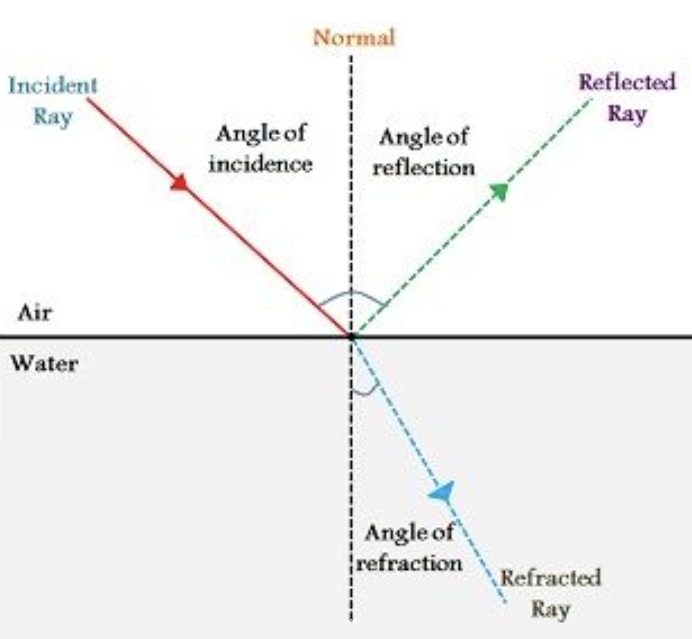 |
Air to Water: Light slows down moderately and bends towards the normal (i = 40, r = 29)
Air to Glass: Light slows down more and bends even further towards the normal (i = 40, r = 25)
Order of Optical Density (least to most dense): Air - Water - Glass.
21) Does dividing the angle of refraction by the angle of incidence give a constant ratio ?
No. These are not directly proportional.
22) What is Displacement ?
Calculate the speed of a wave that has a wavelength of 42 cm and a frequency of 11 hertz.
speed = frequency x wavelength
23) What is a Mechanical Wave ?
This is a wave that is an oscillation of matter and requires vibration in a solid, liquid or gas.
These can travel through air and solid materials (not through a vacuum)
Examples include - sound, water, stretched string
Sound Waves
24) What is Sound ?
These are longitudinal waves that need a medium to travel through.
It is impossible for sound to travel through a vacuum because there are no air molecules to vibrate.
25) What is the speed of Sound ?
The distance sound travel in one second (330 m/s)
26) What is a Pressure Wave ?
It is a wave that has a repeating pattern of high pressure regions and low pressure regions (for example sound)
27) What is an Oscilloscope ?
A device that is able to view patterns of sound waves that have been turned into electrical signals.
This can measure the speed of sound.
28) How does Frequency affect Sound ?
The frequency of a sound wave determines its pitch.
A high frequency results in a high pitch sound (like a whistle).
A low frequency results in a low pitch sound (like a bass drum).
29) What is the Pitch of a wave ?
The pitch of a sound wave is how high or low the sound is.
30) How are Pitch and Frequency related ?
A low pitch sound has a low frequency.
A high pitch sound has a high frequency.
31) What are Compressions and Rarefractions ?
These are the names given to alternating high-pressure and low-pressure regions that make up a longitudinal wave.
Compression - The particles are pushed closer together creating an area of high pressure and high density. For example in a tuning fork, when the prong moves outward, pushing neighbouring air particles together.
Rarefaction - The particles are spread further apart creating an area of low pressure and low density. For example in a tuning fork, when the vibrating prong moves inward, leaving more space for air particles to spread out.
32) How does a Loudspeaker work ?
It uses an electromagnet to make sound from a varying potential difference.
It turns an electrical signal into a pressure wave of sound.
The changing P.d. causes changes in air pressure.
33) How does a Microphone work ?
sound can be detected with a microphone.
It turns any pressure waves that hit is into an electrical signal (or potential difference)
34) What do you need to do to a sound wave to make it louder ?
Increase the amplitude.
35) What is an Echo ?
Reflection of sound waves from a surface back to the listener
36) Can you give the names of some of the bones in the inner ear ?
hammer, anvil, stirrup
37) Can you give the names of some of the bones in the outer ear ?
pinna, auditory canal, eardrum
38) What is Ultrasound ?
Sound at a frequency greater than 20,000 Hz
this is beyond the range of human hearing
39) What frequency can humans hear ?
Between 20-20,000 Hz
40) What are Decibels ?
The unit used to measure the loudness of sound.
Visible Light
41) What is Visible Light ?
These are transverse waves that do not need a medium to travel through.
They have a frequency that human eyes can detect.
42) What is the speed of Light ?
The distance light travels in one second (300 million m/s)
43) What is Ultraviolet light ?
These are light waves that have a higher frequency than the light that human eyes can detect.
44) What are the 3 Primary colours ?
Red, Blue, Green
All colours can be broken down into different combinations of the three primary colors.
45) What is a Secondary colour ?
It is a colour obtained by mixing two primary colours together.
R + B = Magenta
R + G = Yellow
B + G = Cyan
46) What colour would these objects be ?
blue object in blue light (blue)
blue object in red light (black)
blue object in green light (black)
yellow object in red light (red)
yellow object in blue light (black)
47) What is a Lens ?
A device made up shaped glass that focuses light rays from objects to form an image
48) What is the difference between a Concave Lens and a Convex Lens ?
Concave - A lens that is thinner in the middle and that spreads out light rays
Convex - A lens that is thicker in the middle and that bends light rays towards each other
49) What is a Shadow ?
A shadow is formed when light travelling in straight lines from a light source is blocked by an opaque object.
50) What is a Mirror ?
Is an object that reflects light at the same angle that it hits.
51) What is Converging ?
Bringing rays of light together
52) What is Dispersion ?
Splitting up of a ray of light of mixed wavelengths into separate components by using refraction
53) What is Diverging ?
The type of lens that spreads light out and forms a virtual image
54) What is the Focal Point ?
The point at which light rays refracted by a convex lens cross over
55) What is Opaque ?
A material that does not allow light to pass through it
56) What is a Non-Luminous object ?
An object that produces no light.
57) What is the optic nerve ?
A pair of sensory nerves that run from each eye to the brain.
58) What are the difference parts of the eye called ?
Pupil - the hole in front of your eye called where light goes in.
Iris - the coloured part of your eye called.
Retina - the back of the eye where the image is formed.
Cornea - the transparent layer at the front that refracts light.
59) What is a Spectrum ?
A band of light produced when light is spread out by a prism.
60) What is a Translucent material ?
A material that allows some light to pass through it
61) What is a Transparent material ?
A material that allows all light to pass through it.
Practice
62) If a wave has a frequency of 12.0 x 10(6) Hz and a speed of 3.0 x 10(8) m/s, what is the wavelength ?
63) If a wave has a speed of 0.15 m/s and a wavelength of 7.5 cm, what is the frequency ?
64) Does a convex lens always produce a real image ?
No. A convex lens produces a real image when the object is placed further away than its focal length.
A convex lens produces a virtual image and magnified image when the object is placed between the lens and the focal point.
65) What is the difference between a real image and a virtual image ?
Real Image - formed when light rays converge and can be projected into a screen.
Virtual Image - formed when light rays appear to diverge from a point and cannot be projected onto a screen.
66) Can visible light travel through a vacuum ?
Yes. Visible travels through the vacuum of space when it travels from the sun to earth.
67) When white light crosses between air and glass it can split up into the colours in the spectrum.
Explain in terms of speed, why the light behaves like this.
White light is a mixture of colours and there are seven different colours (red, orange, yellow, green, blue, indigo, violet)
Each colour has a different wavelength
All colours travel at the same speed in air, they slow down by different amounts when entering glass.
Violet has the shortest wavelength, slows down the most.
Each colour has a slightly different angle of refraction.
68) A ray of light travels from air into a rectangular glass block at an angle of incidence of 40 degrees.
Is the angle of refraction inside the glass greater than, equal to, or less than 40 degrees.
Light slows down as it enters the optically denser glass, causing it to bend towards the normal.
So the angle of refraction is less than the angle of incidence.
69) A student investigates how the angle of refraction changes with the angle of incidence for a Perspex block using a ray box
Explain why the student should use a ray box with a narrow slit rather than a wide beam of light
A narrow ray makes it easier to find the centre of the beam / mark the path accurately,
reducing random error when measuring angles with a protractor
When the angle of incidence was 40 degrees, the student recorded three repeat measurements for the angle of refraction: 28, 25 and 22 degrees. Calculate the uncertainty in the angle of refraction.
Range = 28 - 22 = 6. Uncertainty is 6/3 = 2
© 2026 Better Solutions Limited. All Rights Reserved. © 2026 Better Solutions Limited TopPrevNext