Inserting
Rather than entering your formulas through the Formula Bar you can just enter them directly into the cells.
This is the preferred method for a lot of people who are familiar with the function arguments.
Try to avoid hard coding values into formulas. Enter the data into cells and then reference the cells.
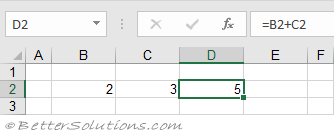
In this very simple example a formula is used in cell D2 to calculate the total of the values in cell B2 and C2.
The advantage of using a formula is that it is updated automatically, when the cells that it refers to change.
Once you have finished the formula, press Enter to confirm.
After you have pressed Enter the cell will display the result of the formula as opposed to the actual formula.
 |
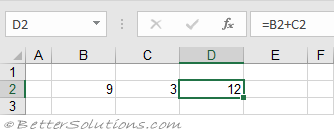
If we change the value in cell B2 to 9, the formula is re-calculated automatically and the correct result is displayed.
 |
The table below shows the formula entered in column B and the result obtained in column C.
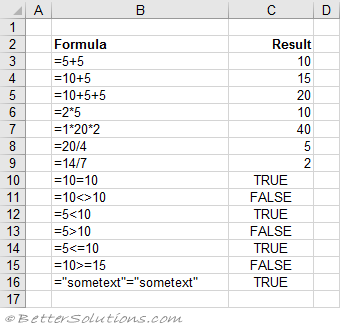 |
All the formulas contain basic operations such as addition, subtraction, multiplication and division.
To represent these operations you use what are called Operators in between your numbers.
When you create a formula you need to include at least one operator.
Equal To (=) Operator
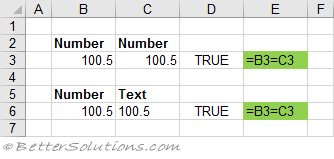
A1 = B1
This will match even if one of the cells is formatted as a number and the other one is formatted as text
 |
Parentheses
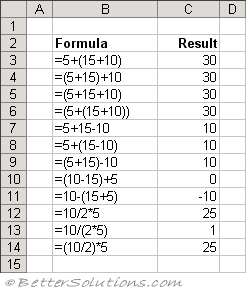
Parentheses are basically brackets. Using brackets in your formulas is a good habit to get into even when they are not strictly needed because they help to clarify the order and make the formula easier to understand.
It is also possible to put parentheses within parentheses. When parentheses are nested the ones on the inside are evaluated first.
When you enter parentheses you will notice that Excel tries to help you by making the matching parentheses bold as you pass over it with the mouse.
Your parentheses must balance. For every open parentheses there must be a corresponding close parentheses. If you try to submit a formula which does not contain the same number of open and close parentheses, Excel will prompt you and tell you that the formula you have entered is incorrect. Excel will make a suggestion as to what it thinks the formula should be. You can accept the recommendation or press "No" to edit the formula yourself.
The table below shows the more formulas entered in column B and the result obtained in column C.
 |
Spaces
You can put spaces between your formula arguments.
Not before the leading equal sign
Not between a function name and its opening parenthesis
Not within compound logic operations, such as less than or greater than
String Concatenation
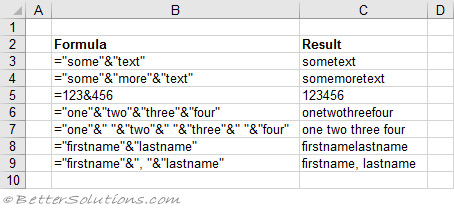
The string concatenation "&" operator is also known as the ampersand.
This operator can be used to join several text strings together into a single string.
When a text string is used within a formula the characters must be enclosed in speech marks " ".
You can use this operator to join any two values (text or numeric) in order to create a single text string.
 |
© 2026 Better Solutions Limited. All Rights Reserved. © 2026 Better Solutions Limited TopPrevNext